
Currently Empty: ₹0.00
Fertility & Reproductive Sciences
The Growing Demand for Clinical Embryologists: Career Opportunities, Skills, and Future Outlook
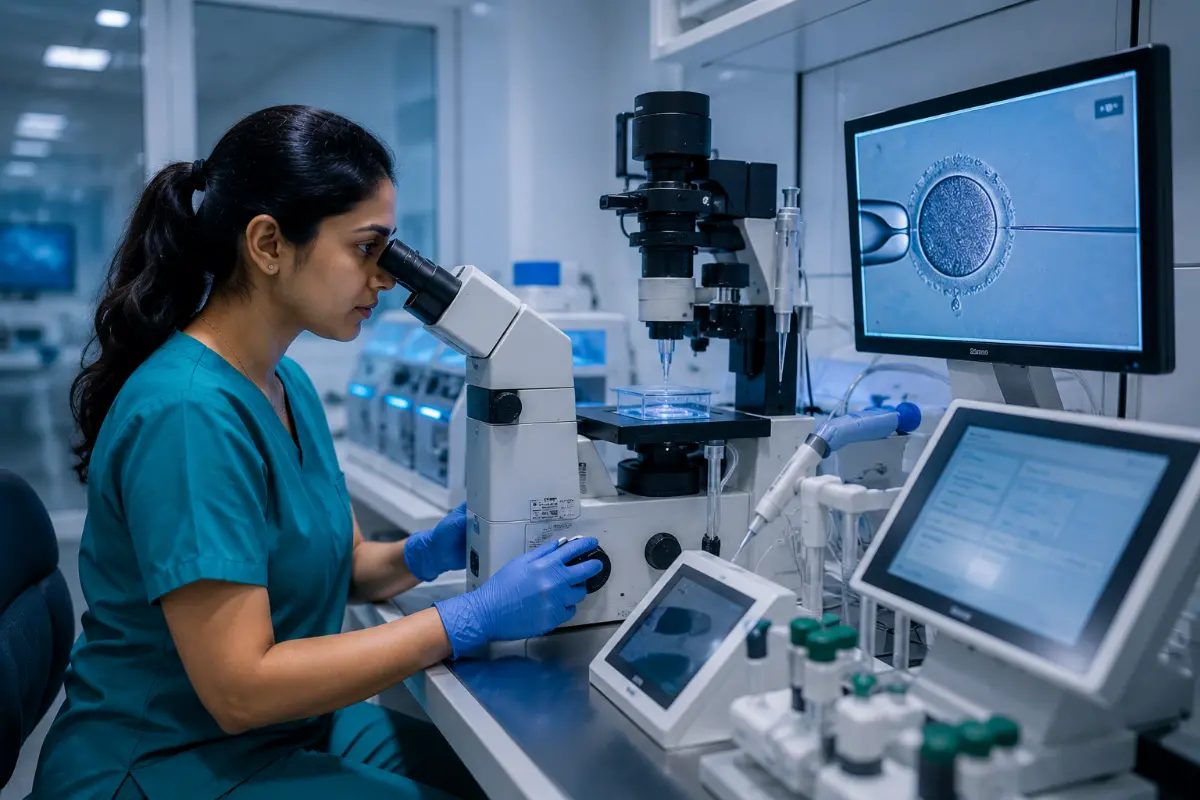
Among the many specialized careers emerging within healthcare, Clinical Embryology has become one of the most exciting and rapidly growing fields.
With increasing awareness of fertility treatment, delayed parenthood, lifestyle-related infertility, and advancements in Assisted Reproductive Technology (ART), the demand for skilled embryologists continues to rise across India and globally.
For life science graduates and healthcare professionals seeking a highly specialized and impactful career, embryology offers a unique combination of science, technology, and patient impact.
What Does a Clinical Embryologist Do?
Clinical embryologists play a critical role within IVF laboratories.
They are responsible for handling and monitoring reproductive cells and embryos throughout the fertility treatment process.
Their responsibilities often include:
- Oocyte (egg) assessment
- Sperm preparation
- Fertilization procedures
- Embryo culture
- Embryo grading
- Cryopreservation
- Laboratory quality control
- Documentation and compliance
Every stage requires precision, attention to detail, and strict adherence to laboratory protocols.
Why Demand is Increasing
Several factors are driving the need for trained embryologists.
Rising Infertility Rates
Infertility affects millions of couples worldwide.
Modern lifestyle factors, delayed family planning, stress, environmental influences, and certain medical conditions have contributed to increasing fertility challenges.
As a result, more couples are seeking fertility treatment than ever before.
Expansion of IVF Centres
India has witnessed significant growth in fertility centres over the past decade.
Major metropolitan areas continue to see new IVF centres opening, while fertility services are also expanding into Tier-2 and Tier-3 cities.
Each IVF laboratory requires qualified embryologists to ensure safe and effective laboratory operations.
Technological Advancements
Modern fertility laboratories utilize advanced technologies such as:
- Time-lapse embryo monitoring
- Vitrification systems
- Micromanipulation equipment
- Digital laboratory management systems
- AI-assisted embryo assessment
These technologies require trained professionals capable of operating sophisticated laboratory environments.
Why Clinical Embryology Is Unique
Unlike many healthcare careers, embryology combines:
Biology
Understanding reproductive cells and embryo development.
Laboratory Science
Maintaining highly controlled laboratory environments.
Technology
Working with advanced imaging and micromanipulation systems.
Patient Impact
Contributing directly to helping individuals and couples build families.
Many embryologists describe their work as one of the most meaningful careers within healthcare.
Essential Skills for Successful Embryologists
Attention to Detail
Even minor laboratory variations can influence outcomes.
Scientific Curiosity
Embryology requires a strong understanding of reproductive biology and developmental science.
Precision and Dexterity
Many procedures involve delicate laboratory techniques.
Quality Focus
Laboratory standards and quality control are critical.
Continuous Learning
The field continues to evolve rapidly through research and technological innovation.
Career Opportunities in Embryology
Qualified embryologists may pursue opportunities in:
IVF Centres
The most common career pathway.
Fertility Hospitals
Supporting comprehensive reproductive healthcare services.
Research Institutions
Contributing to advancements in reproductive science.
Academic Institutions
Teaching and training future embryologists.
International Fertility Centres
Many experienced embryologists pursue opportunities abroad.
The Importance of Structured Training
Embryology is a highly specialized field.
While academic qualifications provide a foundation, practical laboratory exposure is often essential for developing professional competence.
Structured programmes such as:
- Fellowship Programmes
- Advanced ART Courses
- Clinical Embryology Training
- Laboratory Workshops
help professionals develop both theoretical understanding and practical skills.
Learning from experienced embryologists and fertility specialists can significantly accelerate career development.
Future Trends in Embryology
The future of embryology is likely to be shaped by:
Artificial Intelligence
AI-assisted embryo selection and laboratory analytics.
Automation
Enhanced laboratory efficiency and quality control.
Genetic Technologies
Advances in embryo assessment and reproductive genetics.
Personalized Fertility Care
More individualized treatment approaches.
These developments will create additional opportunities for skilled embryologists who embrace innovation and continuous learning.
Why Now Is a Good Time to Enter the Field
Several trends make embryology particularly attractive today:
- Growing demand for fertility services
- Expansion of IVF infrastructure
- Increasing awareness of infertility treatment
- Advancements in reproductive technologies
- Limited availability of highly trained specialists
As demand continues to grow, qualified embryologists are likely to remain valuable members of fertility healthcare teams.
Final Thoughts
Clinical Embryology is one of the most specialized and rewarding careers within modern healthcare.
For professionals passionate about science, technology, and making a meaningful difference in people’s lives, embryology offers exciting opportunities for growth and professional fulfillment.
As fertility care continues to evolve, skilled embryologists will play an increasingly important role in shaping the future of reproductive medicine.